Foundation
Startups exhibit a number of patterns that are deeply interesting, and there is many an article online that can be found describing those in great detail. I often tend to frame ideas from an individualistic perspective, and from my own experience and talking to others in the startup world have coined a term ’the paradox of scale’ that I rarely see discussed directly.
Working at a startup forces you to show up every day - the ‘thing’ needs doing, and nobody else is going to do it for you - The reason for this is two-fold:
- You have limited runway - The company is not profit-generating and needs to demonstrate value quickly or risks shutdown.
- Headcount is small - few people are working on the problem such that individual impact is high.
The ‘thing’ here, being a startup, is generally novel, untested, and shrouded by uncertainty. This combined with the above factors means you are constantly staring into the abyss in this world.
The founder feels the effects of this the most. Early employees sign up to this deal too and will share many of these trials with the founder. Visually, the structure of a startup can be modelled in the form of concentric circles, with the founder at, or near the centre. Employees spanning out from this.
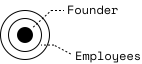
Since headcount is low, this is a very basic model and not much is going on. Another way one might think of this is for the centre of this model to be a black hole. Its encompassing grasp represents the destruction of the company should it not be able to achieve what it set out to do.
The rings, spaced gradually further away represent the founder and employees. As you get progressively further from the centre, the force the black hole can exert weakens. Remember it is the founder that feels this pressure the most.
The mission in creating an enduring company is to push these rings away from the centre. Towards a region without such extreme force and uncertainty.
Early in a startup however, all employees will feel the effects of this force. That isn't necessarily a bad thing. By seeking such pressure you are continually filled with purpose. There is little ambiguity as goals become very clear with little room to manoeuvre - they need be because of point 1. Level of ownership is also extremely high, you will wear many hats, and face difficult problems - this is from point 2.
Scaling
As the company progresses on this mission (scaling) the model changes. Headcount grows and chains of communication lengthen. More circles are beginning to appear around the centre point.
More subtlety however, the annulus (gap between circles ,and most importantly the central point) expands. What was once the startup is no more, the company is maturing and is approaching escape velocity. The pull towards the centre has weakened.
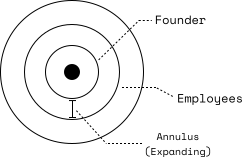
Oddly this is where the paradox of scale is met:
Organisations scale by removing the very constraints that create individual purpose.
The company is achieving exactly what it set out to do and is a success by all standard measures. Day-to-day pressure has been released as doom is no longer impeding. The runway has extended and greater deliberation can be taken. Yet there is a side effect is taking place…
Individuals not longer feel the pressure that existed before, they begin to relax. But this was the driving force of meaning, focus, and clarity evident in the early stages. Employees begin to lose the obsession, timelines prolong further and further. The magic has been lost.
This is why many, myself included, will recommend working at a startup some point in your career. It imbues a certain mentality within you that is difficult to replicate otherwise. It will of course be difficult, but that is by design. Trivial, exogenous stuff is non-existent when there is no room for it. Ideas become reality in a matter of days or hours. Every feature, sale, or mention feels like a lifetime being extended.
The machine is lean and efficient. When done right, it is a beautiful thing to witness, and even better to be part of.
Footnote
I don’t believe it fully impossible to replicate this elsewhere but faces many challenges. Generally this appears via two methods:
Founder driven
Organisations that continue to have a strong founder / leader presence as they scale / mature can keep this alive. Typically through being the best example themselves (If employees see the founder grinding, they are more likely to also), and in how their messaging is structured and delivered e.g. a sense of urgency or strong mission (see “it’s often easier to succeed with a hard startup than an easy one”.
You can spot these as companies that are often still discussed in startup terminology, yet are many funding rounds deep or matured beyond this. They often set a high bar for talent and offer good compensation.
Self-driven
One can embody this mentality themselves daily. I list this after founder-driven in that the above option method is technically also self-driven, yet with a distinction. The founder holds greater control over the organisation as a whole and more weight in their actions. That means, still via persistence, what they say / do will permeate throughout and have some holding force.
An individual can do this but the behaviour is a lot less sticky. Habits are hard to break. Furthermore trying to get your peers aligned on the same mindset once certain behaviours have been formed is near impossible. It’s much easier to seek the environment that embodies these traits rather than attempting to bend the world to your thinking.